The Particle Number Paradigm: Why ApoB and Lp(a) Make Standard Cholesterol Panels Obsolete
Standard LDL-C measures the cargo, but ApoB measures the vehicles. Discover how atherogenic particles penetrate vascular endothelium and how to halt plaque progression.
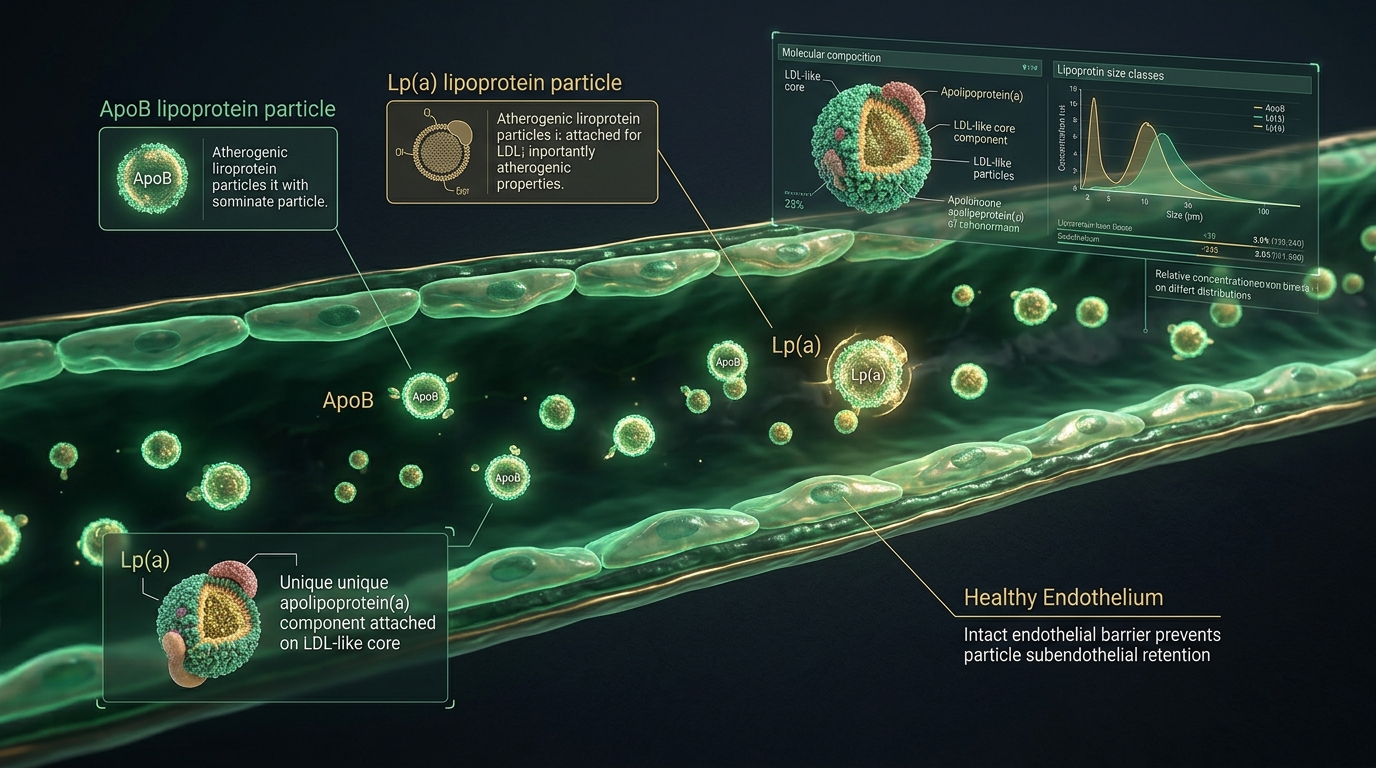
For nearly seven decades, clinical medicine has evaluated cardiovascular risk through a single, deceptively simple laboratory test: LDL-C (Low-Density Lipoprotein Cholesterol).
Patients are routinely informed that their cholesterol is "within the normal reference range" if their calculated LDL-C rests comfortably below 100 mg/dL. Yet every single day, emergency departments admit individuals experiencing acute myocardial infarctions whose standard lipid panels were completely unremarkable just weeks prior.
In Medicine 3.0, we confront an undeniable physiological reality: LDL-C does not measure the primary driver of cardiovascular disease. It measures the passenger, not the vehicle.
To eliminate atherosclerotic cardiovascular disease (ASCVD)—the world's number one killer—we must shift from measuring cholesterol concentration to measuring particle concentration through ApoB (Apolipoprotein B) and its genetically amplified variant, Lp(a) [Lipoprotein(a)].
1. The Physics of the Arterial Wall: Passenger vs. Vehicle
To understand why standard cholesterol panels fail, imagine a bustling highway:
- Cholesterol (LDL-C) is the cargo (the number of passengers inside cars).
- Atherogenic Lipoproteins are the cars themselves.
The endothelium—the single-cell thick lining guarding your arterial walls—does not have a sensor for cholesterol concentration. Instead, arterial plaque formation is governed by a purely mechanical process known as subendothelial particle retention.
Every single atherogenic particle that carries cholesterol—including LDL, VLDL, and IDL—is wrapped in exactly one single molecule of Apolipoprotein B (ApoB-100).
When an atherogenic particle collides with an area of endothelial micro-injury or turbulent blood flow (such as an arterial bifurcation), it can cross the endothelial barrier and become trapped in the subendothelial space by binding to proteoglycans. Once trapped, the particle undergoes oxidation, triggering an innate immune cascade: macrophages arrive, engulf the oxidized lipids, transform into foam cells, and initiate the necrotic core of an atherosclerotic plaque.
Key Takeaway: It does not matter how much cholesterol is inside a particle. One particle trapped equals one atherogenic insult. Measuring ApoB provides the exact, direct particle count of circulating atherogenic invaders.
2. Discordance: Why "Normal" LDL-C Can Be Lethal
In a large percentage of the population—especially those with early insulin resistance, metabolic syndrome, or high triglycerides—there is a severe discordance between LDL-C and ApoB.
When triglycerides are elevated and hepatic insulin sensitivity is impaired, the liver secretes smaller, cholesterol-depleted LDL particles. Because each particle carries less cholesterol, your total LDL-C test may look surprisingly low (e.g., 85 mg/dL). However, because the body still has the same or higher volume of circulating particles, your ApoB count might be 110 mg/dL (extremely high risk).
According to a landmark meta-analysis published in the Journal of the American College of Cardiology (JACC) and European Heart Journal (Ference et al., PMID: 28444290, DOI: 10.1093/eurheartj/ehx144):
- Cardiovascular risk correlates linearly with the cumulative lifetime exposure to ApoB particles, completely independent of LDL-C.
- Maintaining ApoB below 60 mg/dL halts the progression of arterial plaque, and levels below 50 mg/dL can achieve regression of soft plaque.
3. Lipoprotein(a): The Stealth Genetic Accelerator
While ApoB reflects lifestyle and metabolic factors that you can heavily influence through nutrition and exercise, Lp(a) is approximately 90% genetically determined.
Lp(a) consists of an ApoB-containing LDL-like particle bound covalently to an additional glycoprotein called Apolipoprotein(a). This unique structural appendage resembles plasminogen, conferring both atherogenic and thrombogenic properties:
- It accelerates vascular micro-calcification.
- It competitively inhibits tissue plasminogen activator (tPA), making blood clots far more resistant to natural breakdown.
According to the European Atherosclerosis Society Consensus Statement (PMID: 36017534, DOI: 10.1093/eurheartj/ehac361), approximately 20% of the global population carries an Lp(a) level greater than 75 nmol/L (or > 50 mg/dL), representing an independent hazard ratio for early stroke, aortic stenosis, and heart attacks.
How to Manage Elevated Lp(a)
Because Lp(a) is genetic and largely resistant to dietary modification, the clinical strategy in Medicine 3.0 focuses on removing all co-synergistic drivers of vascular damage:
- Drive overall ApoB particle count below 50 mg/dL: If there are fewer total ApoB particles circulating, Lp(a) particles have fewer opportunities to penetrate the endothelium.
- Extinguish vascular inflammation (hs-CRP < 0.5 mg/L): High-dose EPA/DHA omega-3 fatty acids and endothelial nitric oxide support prevent the micro-injury necessary for Lp(a) to stick.
- Optimize Blood Pressure (< 120/80 mmHg): Eliminates laminar shear injury that tears endothelial junctions.
4. The Actionable Longevity Protocol for Atherogenic Lipoproteins
If your Habitspan Biomarker Vault indicates elevated ApoB (> 80 mg/dL) or an elevated TG/HDL ratio (> 2.0), implement this targeted four-pillar intervention:
1. High-Viscosity Fiber (The Bile Acid Trap)
Consume 10 to 15 grams of viscous soluble psyllium husk dissolved in water immediately before your largest meal. Soluble fiber binds bile salts in the small intestine, preventing their reabsorption into the enterohepatic circulation. To synthesize replacement bile acids, the liver must pull circulating ApoB particles from your bloodstream via hepatic LDL receptor upregulation.
2. Saturated Fat Replacement
Substitute industrial butter, palm oil, and heavy dairy fats with high-polyphenol extra virgin olive oil (>30 mL/day) and cold-water marine omega-3s. Oleic acid and omega-3s maintain optimal hepatic LDLR membrane fluidity, preventing receptor downregulation.
3. High-Volume Zone 2 Aerobic Work (180+ min/week)
Sustained aerobic exercise at 60–70% max heart rate forces working skeletal muscle to clear free fatty acids and accelerates hepatic lipid turnover, preventing the oversecretion of atherogenic VLDL particles.
Clinical Research & Evidence Citations
- Ference, B. A., et al. (2017). Low-density lipoproteins cause atherosclerotic cardiovascular disease: 1. Evidence from genetic, epidemiologic, and clinical studies. European Heart Journal, 38(32), 2459–2472. PubMed PMID: 28444290 | DOI: 10.1093/eurheartj/ehx144
- Kronenberg, F., et al. (2022). Lipoprotein(a) in health and disease: European Atherosclerosis Society Consensus Statement. European Heart Journal, 43(39), 3925–3946. PubMed PMID: 36017534 | DOI: 10.1093/eurheartj/ehac361
- Sniderman, A. D., et al. (2019). Apolipoprotein B Particles and Cardiovascular Risk: Clarifying the Discordance. JAMA Cardiology, 4(12), 1287–1295. PubMed PMID: 31642874
Recommended Reading
To deepen your understanding of modern longevity science, cardiovascular architecture, and compound biological assets, explore these foundational works:
- Peter Attia, MD — Outlive: The Science and Art of Longevity The defining text on Medicine 3.0, tactical cardiovascular risk elimination, and the Centenarian Decathlon.
- Eric Topol, MD — The Creative Destruction of Medicine A masterclass on how digital biomarker tracking and genomic profiling are personalizing cardiovascular therapeutics.
- Naval Ravikant — The Almanack of Naval Ravikant Essential principles on compounding longevity, leverage, and health as the ultimate non-negotiable form of wealth.
Actionable Longevity Checklist: Next Steps
Scientific insights have maximum power when translated into micro-habits. Check off your daily targets:
Log in Habitspan Daily Protocol (15s)
Lock your 4 biological pillars daily with zero friction and zero tedious data entry.
Calculate Your Biological Cell Age
Assess your functional longevity score against chronological birth age using Medicine 3.0 metrics.