The Female Infradian Rhythm: Why Women Shouldn't Fast Like Men and the Science of Cycle-Synced Longevity
Standard intermittent fasting protocols were overwhelmingly designed on male physiology. Discover why prolonged fasting crashes kisspeptin, thyroid conversion, and progesterone in women—and how to cycle nutrition for lifelong healthspan.
For the past decade, intermittent fasting (IF) has been heralded as the holy grail of biohacking and longevity: a simple, non-pharmacological tool that triggers cellular autophagy, clears senescent debris, reduces systemic inflammation, and restores insulin sensitivity.
Yet, a silent epidemic has unfolded in clinic waiting rooms worldwide: thousands of health-conscious women adopting rigid 16:8 or 24-hour fasts, only to experience sudden hair thinning, severe insomnia, mood dysregulation, missed menstrual cycles (hypothalamic amenorrhea), and unexplained weight gain around the midsection.
Why does a protocol that produces peak energy and rapid fat loss in men frequently trigger metabolic and hormonal rebellion in women?
The answer lies in evolutionary endocrinology: Women possess a second biological clock that men do not.
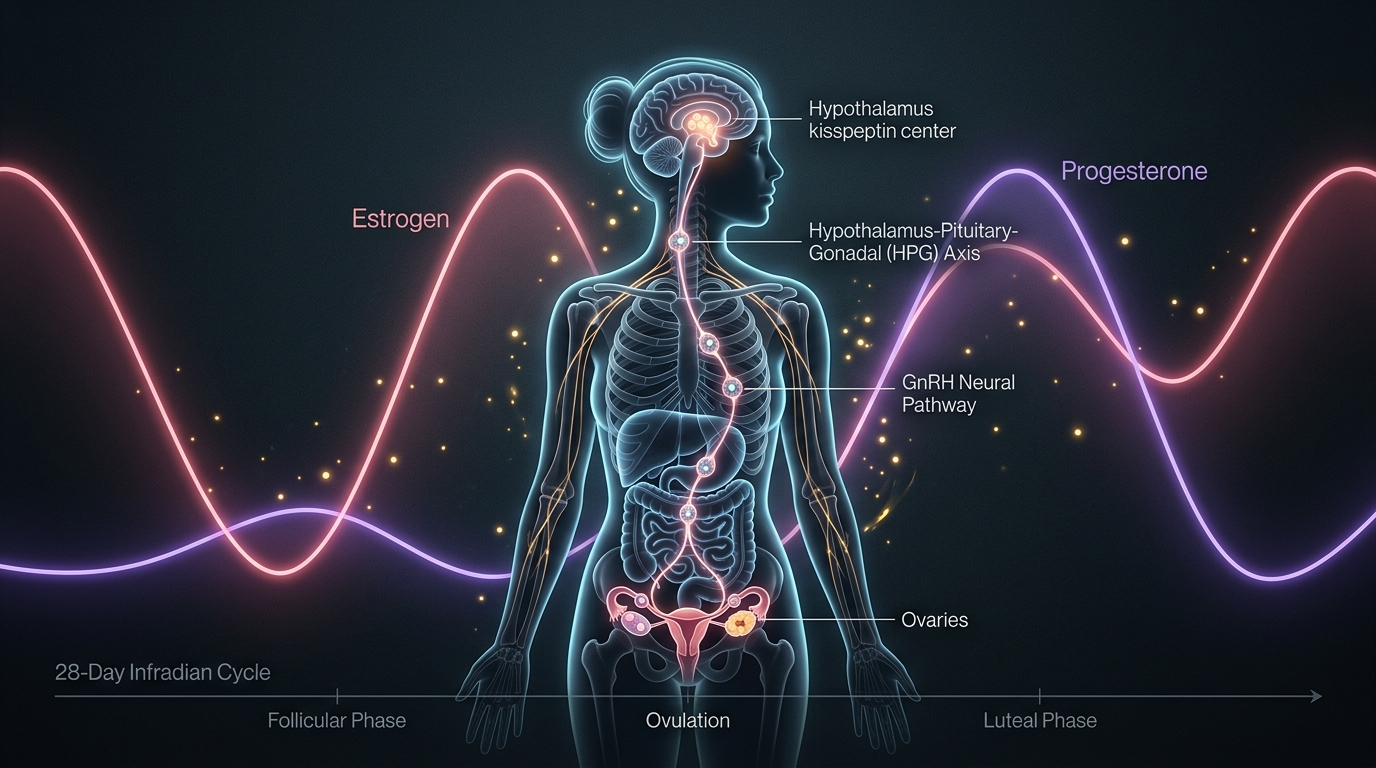
While male biochemistry is governed almost entirely by a 24-hour Circadian Rhythm, reproductive-age female physiology is governed by a 28-day Infradian Rhythm. Ignoring this fundamental biological architecture turns a therapeutic longevity tool into a chronic neuroendocrine stressor.
1. The Neurobiology of Female Energy Sensing: The Kisspeptin Alarm
To understand why women respond differently to caloric restriction, we must examine the hypothalamic control center of the female brain.
Women’s brains possess an evolutionary sensor called Kisspeptin neurons located within the arcuate and anteroventral periventricular nuclei of the hypothalamus. Kisspeptin acts as the master conductor for Gonadotropin-Releasing Hormone (GnRH), which directly dictates the secretion of Luteinizing Hormone (LH) and Follicle-Stimulating Hormone (FSH).
The Female Hypothalamic Energy Cascade (Fasting vs. Fed State)
- Higher Sensitivity: Female kisspeptin neurons express significantly higher levels of leptin and estrogen receptors than male kisspeptin neurons.
- The Famine Reflex: When a woman fasts for prolonged durations, intracellular ATP drops, and cellular AMPK (AMP-activated protein kinase) spikes. While AMPK is beneficial for autophagy, in female hypothalamic neurons it directly suppresses kisspeptin transcription.
- The Downstream Crash: Without kisspeptin, GnRH pulses become erratic. The pituitary halts LH and FSH secretion, signaling to the ovaries that the body is in an active famine. The brain intentionally suppresses ovulation and down-regulates thyroid conversion to conserve metabolic energy for survival.
2. The 3 Major Hormonal Collisions of Prolonged Female Fasting
When a woman fasts aggressively (e.g., daily 18:6 fasts, OMAD, or multi-day fasts) without respecting her menstrual cycle, three critical hormonal disruptions occur:
1. The Progesterone Crash & Cortisol Hijack
Progesterone is the primary soothing, sleep-promoting, and anti-anxiety hormone in women. Unlike estrogen, which thrives in an insulin-sensitive, low-fuel environment, progesterone synthesis requires sufficient blood glucose and low systemic cortisol.
- When you fast during the second half of your cycle (the Luteal Phase), the body perceives energy deprivation as physiological stress.
- Cortisol surges to mobilize hepatic glucose. High cortisol directly competes for progesterone receptors and inhibits the corpus luteum from producing adequate progesterone.
- The Result: Severe PMS, anxiety, waking up at 3:00 AM drenched in sweat, breast tenderness, and mood irritability.
2. Thyroid T4-to-T3 Conversion Blockade
The thyroid gland is the metabolic furnace of the body. The active thyroid hormone, Free T3 (Triiodothyronine), dictates cellular metabolic rate and body temperature.
- Peripheral conversion of storage T4 into active T3 in the liver requires insulin and adequate glycogen stores.
- Chronic carbohydrate restriction and uncalibrated fasting elevate Reverse T3 (rT3)—an inactive mirror molecule that blocks T3 receptors.
- The Result: Cold hands and feet, stubborn fat accumulation, sluggish bowel motility, and hair shedding.
3. Sarcopenic Muscle Loss & Metabolic Slowdown
Women naturally possess lower baseline skeletal muscle mass than men. During extended fasts (>16–18 hours), hepatic glycogen depletes. In the presence of elevated cortisol, the body breaks down precious branch-chain amino acids from skeletal muscle via gluconeogenesis.
- Sarcopenia (loss of lean muscle) reduces your primary metabolic sink for glucose disposal, paradoxically increasing long-term risk of insulin resistance.
3. The 4-Phase Infradian Fasting & Nutrition Protocol
To reap the life-extending benefits of autophagy and metabolic flexibility without destroying hormonal equilibrium, women must practice Cycle-Synced Intermittent Fasting:
| Cycle Phase | Cycle Days | Hormonal Dominance | Fasting Window | Nutritional & Training Focus |
|---|---|---|---|---|
| Follicular Phase | Day 1–10 | Estrogen building, high insulin sensitivity | 13–16 Hours | High protein (1.6–2.0g/kg), low-carb, heavy resistance training |
| Ovulation Window | Day 11–15 | Peak estrogen & testosterone spike | 13–14 Hours | Cruciferous vegetables (DIM/Sulforaphane), fiber, liver detox support |
| Early Luteal Phase | Day 16–21 | Progesterone rising | 12–13 Hours (Gentle) | Clean complex carbs (sweet potatoes, quinoa), anti-inflammatory foods |
| Late Luteal (Pre-PMS) | Day 22–28 | Peak progesterone, high cortisol sensitivity | NO FASTING (10–12h Max) | Progesterone support, magnesium, pumpkin seeds, restorative walking & yoga |
Phase 1: The Follicular Phase (Days 1–10)
- Hormonal Profile: Estrogen and progesterone are at baseline, steadily rising. Insulin sensitivity is at its monthly peak.
- Fasting Strategy: 13 to 16 hours (e.g., finish dinner at 7:00 PM, break fast at 9:00 AM or 11:00 AM).
- Nutritional Focus: High protein (1.6–2.0g/kg) to support muscle synthesis, healthy fats, and fermented foods. Great time for resistance training and Zone 2 cardio.
Phase 2: The Ovulatory Window (Days 11–15)
- Hormonal Profile: Estrogen surges to its maximum monthly peak; testosterone spikes briefly.
- Fasting Strategy: 13 to 14 hours.
- Nutritional Focus: Liver detox support. Estrogen must be properly methylated and cleared by the liver. Prioritize cruciferous vegetables (broccoli sprouts, cauliflower rich in DIM and sulforaphane) and fiber to prevent estrogen dominance.
Phase 3: The Early Luteal Phase (Days 16–21)
- Hormonal Profile: Estrogen dips slightly while progesterone begins its steady climb.
- Fasting Strategy: Gentle 12 to 13 hours (circadian overnight fast only).
- Nutritional Focus: Anti-inflammatory foods, adequate hydration, and moderate clean complex carbohydrates (sweet potatoes, quinoa, berries) with dinner to nourish progesterone production.
Phase 4: The Late Luteal / Pre-Menstrual Phase (Days 22–28)
- Hormonal Profile: Progesterone reaches its zenith. The nervous system is hyper-sensitive to cortisol. Metabolic rate increases by 100–300 kcal/day.
- Fasting Strategy: STRICTLY NO PROLONGED FASTING (10–12 hours maximum).
- Nutritional Focus: Progesterone-building foods rich in Magnesium, Vitamin B6, and Complex Carbohydrates (pumpkin seeds, wild salmon, squash, dark chocolate 85%+). Do not restrict calories. Avoid heavy HIIT or extreme cold plunges; pivot to walking and gentle yoga.
4. What About Menopause & Post-Menopausal Longevity?
For women who have transitioned through perimenopause into post-menopause, the 28-day infradian cycle has concluded. Does this mean post-menopausal women can fast exactly like men?
Not quite. While post-menopausal women can fast more consistently (e.g., 14:10 or 16:8 several days a week), they face two critical biological changes:
- Low Endogenous Estrogen: Increases baseline insulin resistance and accelerates bone mineral loss (osteoporosis).
- Elevated Sarcopenia Risk: Muscle protein synthesis requires a higher leucine threshold (3.0g+ leucine per meal) due to age-related anabolic resistance.
The Post-Menopausal Longevity Rule:
- Never fast at the expense of daily protein targets (minimum 1.6g/kg/day).
- Break every fast with at least 35–40 grams of whole, intact protein (e.g., pasture-raised eggs, wild salmon, or whey isolate).
- Pair fasting with progressive resistance training to protect bone density and muscle mass.
🎙️ Key Takeaways for Your Daily Healthspan Routine
- Women are not small men: Male biology operates on a 24-hour cycle; female reproductive biology is mapped to a 28-day hormonal rhythm.
- Listen to Kisspeptin: Extended energy deprivation signals reproductive famine, triggering HPA axis dysfunction and thyroid slowdown.
- Fast with the cycle: Fast longer (14–16h) during the Follicular Phase when estrogen is high; avoid fasting and nourish carbohydrates during the Late Luteal Phase to protect progesterone.
- Never sacrifice muscle for autophagy: Prioritize 30–40g protein boluses to preserve lean tissue, bone mineral density, and metabolic rate.
Recommended Reading
To explore the clinical science of female endocrinology, cycle-syncing, and longevity biohacking, consider these peer-reviewed and clinically validated texts:
- Outlive: The Science and Art of Longevity by Dr. Peter Attia, M.D.
The authoritative guide to Medicine 3.0, metabolic stability, cardiorespiratory fitness, and personalized healthspan architecture. - Fast Like a Girl: A Woman's Guide to Using the Healing Power of Fasting to Burn Fat, Boost Energy, and Balance Hormones by Dr. Mindy Pelz
A comprehensive clinical roadmap designed specifically for women to harness the metabolic power of fasting in harmony with their monthly cycle. - The Circadian Code by Dr. Satchin Panda, Ph.D.
Foundational research from the Salk Institute detailing how time-restricted eating synchronizes cellular clocks and optimizes endocrine vitality.
Peer-Reviewed Scientific Citations & Landmark Trials
Kisspeptin Neurons and Metabolic Energy Sensing:
Navarro VM. "Metabolic regulation of kisspeptin — the link between energy balance and reproduction." Nature Reviews Endocrinology, 2020 Jul;16(7):407-420.
(Demonstrates how negative energy balance and cellular AMPK activation directly downregulate kisspeptin expression and disrupt GnRH pulsatility in females.)Intermittent Fasting and Female Reproductive Hormones:
Kumar S, Kaur G. "Intermittent fasting dietary restriction regimen negatively influences reproduction in young female rats." PLoS ONE, 2013;8(1):e52416.
(Landmark investigation showing that while male subjects thrived on strict alternate-day fasting, female subjects exhibited disrupted estrous cycling, ovarian shrinkage, and elevated corticosterone.)Infradian Energy Expenditure and Progesterone Requirements:
Barr SI, Janelle KC, Prior JC. "Energy intake are higher during the luteal than the follicular phase of the menstrual cycle in women with normal menstrual cycles." American Journal of Clinical Nutrition, 1995;61(1):39-43.
(Documents the physiological 100–300 kcal basal metabolic rate increase during the luteal phase and the necessity of adequate glucose for corpus luteum function.)
Actionable Longevity Checklist: Next Steps
Scientific insights have maximum power when translated into micro-habits. Check off your daily targets:
Log in Habitspan Daily Protocol (15s)
Lock your 4 biological pillars daily with zero friction and zero tedious data entry.
Calculate Your Biological Cell Age
Assess your functional longevity score against chronological birth age using Medicine 3.0 metrics.