Extinguishing Inflammaging: Cellular Inflammation, hs-CRP, and the Vascular Endothelium
Chronic low-grade inflammation silently destabilizes arterial plaques and accelerates senescence. Learn how to target hs-CRP and homocysteine for lifelong vitality.
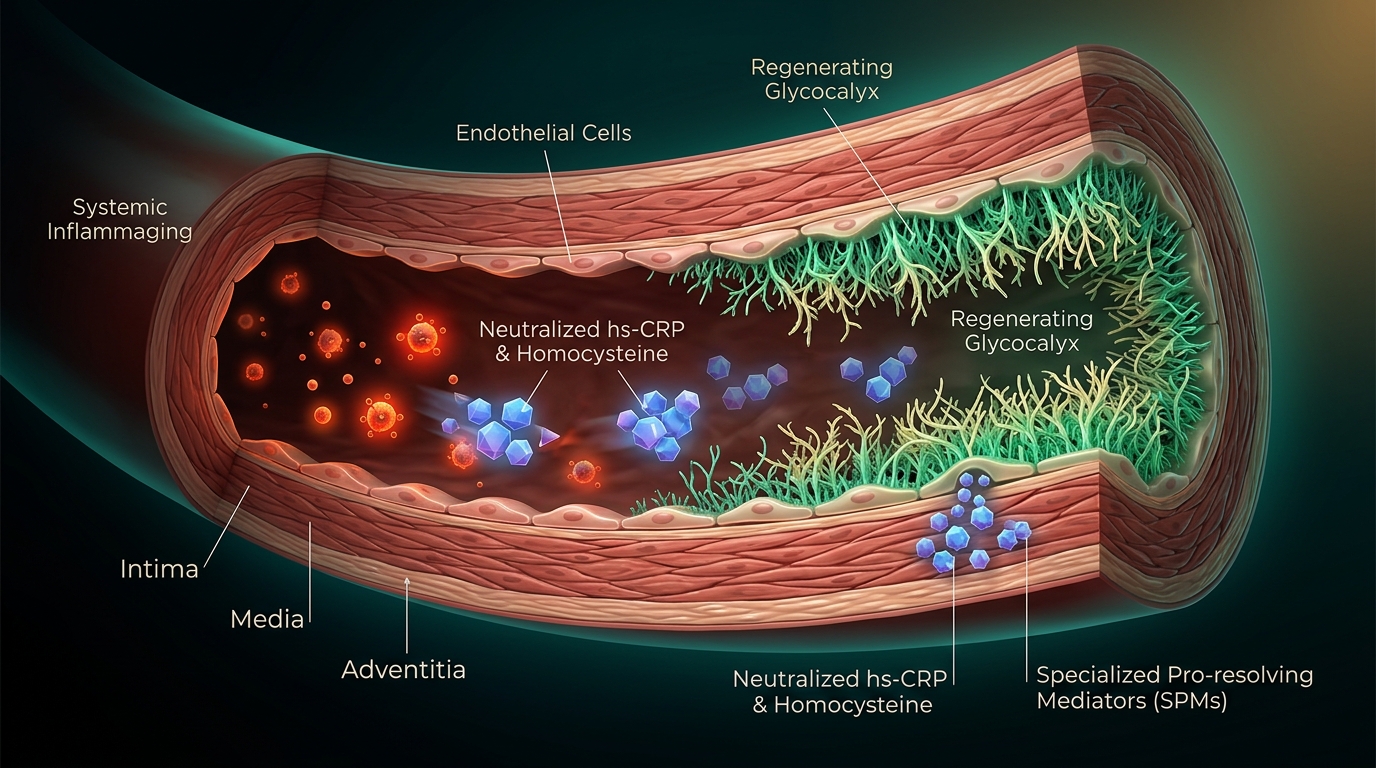
Inflammation is one of humanity’s most brilliant evolutionary adaptations. When an ancient hunter-gatherer stepped on a venomous thorn or sustained a laceration from an apex predator, the immune system mounted a fierce, localized inflammatory storm: white blood cells rushed to the wound, destroyed invasive pathogens, and synthesized fibrin to rebuild tissue.
Once the wound healed, the inflammation extinguished itself.
Today, however, modern humans are rarely threatened by acute microbial sepsis. Instead, we are consumed by a far more insidious physiological phenomenon: Inflammaging.
Inflammaging is a chronic, low-grade, sterile systemic immune activation that simmers silently in the background for decades. It produces no fevers, no visible swelling, and no throbbing pain. Yet it is the common physiological soil from which all four horsemen of chronic disease arise: cardiovascular disease, neurodegenerative decline, type 2 diabetes, and cancer.
In Medicine 3.0, monitoring and extinguishing inflammaging through hs-CRP (high-sensitivity C-reactive protein) and Homocysteine is essential to preserving healthspan into your tenth decade.
1. High-Sensitivity C-Reactive Protein (hs-CRP): The Systemic Fire Alarm
The liver synthesizes C-Reactive Protein (CRP) in direct response to inflammatory signaling molecules released by immune cells, primarily interleukin-6 (IL-6) and tumor necrosis factor-alpha (TNF-α).
While standard CRP tests are calibrated to detect acute bacterial infections or severe autoimmune flares (measuring values up to 50–100 mg/L), the high-sensitivity CRP (hs-CRP) test is capable of measuring micro-quantities down to 0.1 mg/L.
The Danger of Inflammaging in the Arterial Wall
In cardiovascular biology, atherogenesis is not simply an issue of having too many cholesterol particles (ApoB). It is an inflammatory disease:
- Circulating ApoB particles enter the subendothelial space of arterial walls.
- In the presence of systemic inflammation, the endothelial lining loses its protective anti-thrombotic glycocalyx layer.
- Macrophages ingest trapped atherogenic particles and release inflammatory cytokines.
- If hs-CRP remains persistently elevated (> 1.0 mg/L), inflammatory enzymes degrade the fibrous collagen cap covering the plaque.
- When the cap thins and ruptures, blood contacts the necrotic core, instantly forming a thrombus (blood clot) that causes a heart attack or ischemic stroke.
The Landmark CANTOS Trial
The causal role of inflammation in vascular catastrophe was irrefutably proven in the historic CANTOS Trial (Ridker et al., published in the New England Journal of Medicine, PMID: 28845751, DOI: 10.1056/NEJMoa1707914):
- Patients given a targeted anti-inflammatory monoclonal antibody (canakinumab) that reduced hs-CRP without altering cholesterol levels experienced a 31% reduction in secondary cardiovascular events.
- This landmark study confirmed the Inflammatory Hypothesis of Atherosclerosis: keeping hs-CRP below 0.5 mg/L acts as a powerful fire extinguisher against plaque destabilization.
2. Homocysteine: The Endothelial Toxin & Methylation Brake
While hs-CRP reflects generalized systemic immune activation, plasma Homocysteine is a specific metabolic biomarker of vascular toxicity and compromised cellular methylation.
Homocysteine is a sulfur-containing amino acid intermediate formed during the normal metabolism of methionine. Under healthy physiological conditions, homocysteine is immediately recycled back into methionine via one-carbon methylation, utilizing active Vitamin B12 (methylcobalamin) and Folate (L-5-MTHF), or converted into the master antioxidant Glutathione via transsulfuration (requiring Vitamin B6).
What Happens When Homocysteine Rises (> 9 μmol/L)?
When methylation cofactors are deficient, genetic variants (such as MTHFR C677T) are present, or chronic psychological stress depletes methyl donors:
- Homocysteine accumulates in the bloodstream, exerting direct toxic effects on vascular endothelial cells.
- It uncouples endothelial nitric oxide synthase (eNOS), causing blood vessels to lose their ability to dilate smoothly.
- It generates superoxide and hydrogen peroxide radicals, oxidizing circulating LDL and increasing platelet aggregation.
A collaborative meta-analysis of 30 prospective studies published in JAMA (PMID: 12388553, DOI: 10.1001/jama.288.16.2015) demonstrated that:
- Every 3 μmol/L reduction in plasma homocysteine correlates with a 16% lower risk of ischemic heart disease and a 24% lower risk of stroke.
- In Medicine 3.0, the centenarian optimal target for homocysteine is strictly below 9.0 μmol/L.
3. The 4-Pillar Clinical Protocol to Extinguish Inflammaging
If your Habitspan Biomarker Vault indicates elevated hs-CRP (> 1.0 mg/L) or elevated Homocysteine (> 9 μmol/L), deploy this evidence-based tactical protocol:
1. High-Potency EPA/DHA Omega-3 (Resolution Biology)
Consume 2,000 to 3,000 mg of purified EPA/DHA daily. Omega-3 fatty acids serve as the biological substrate for Specialized Pro-Resolving Mediators (SPMs)—lipoxins, resolvins, and protectins—which actively instruct immune cells to halt inflammatory cascades without inducing immunosuppression.
2. Targeted Methylation Support
To rapidly lower homocysteine:
- Supplement with L-5-Methyltetrahydrofolate (L-5-MTHF, 400–800 mcg) and Methylcobalamin (1,000 mcg), completely bypassing genetic MTHFR enzymatic bottlenecks.
- Incorporate dietary Betaine / Trimethylglycine (TMG) from roasted beets, dark spinach, and pasture-raised egg yolks (rich in phosphatidylcholine).
3. Eliminate Refined Seed Oils & Acrolein
Eliminate high-linoleic industrial seed oils (soybean, corn, and cottonseed oil) that are repeatedly heated to high temperatures. These oils generate toxic lipid peroxides and acrolein that irritate intestinal tight junctions, allowing bacterial endotoxins (LPS) into systemic circulation.
4. Non-Negotiable 7.5–8.5 Hours Sleep Window
Sleep deprivation is an immediate trigger for IL-6 and TNF-α release. Deep slow-wave sleep downregulates sympathetic nervous system overdrive and allows the brain's glymphatic system to clear neurotoxic inflammatory debris.
Clinical Research & Evidence Citations
- Ridker, P. M., et al. (2017). Antiinflammatory Therapy with Canakinumab for Atherosclerotic Disease (CANTOS). New England Journal of Medicine, 377(12), 1119–1131. PubMed PMID: 28845751 | DOI: 10.1056/NEJMoa1707914
- Homocysteine Studies Collaboration. (2002). Homocysteine and risk of ischemic heart disease and stroke: A meta-analysis. JAMA, 288(16), 2015–2022. PubMed PMID: 12388553 | DOI: 10.1001/jama.288.16.2015
- Serhan, C. N. (2014). Pro-resolving lipid mediators are leads for resolution physiology. Nature, 510(7503), 92–101. PubMed PMID: 24899309 | DOI: 10.1038/nature13479
Recommended Reading
To further optimize your cellular environment, reduce systemic friction, and cultivate robust stress resilience:
- James Clear — Atomic Habits: An Easy & Proven Way to Build Good Habits & Break Bad Ones The definitive guide to building friction-free daily routines that automate healthy nutrition, sleep consistency, and stress recovery.
- Matthew Walker, PhD — Why We Sleep: Unlocking the Power of Sleep and Dreams A profound scientific exploration of how nocturnal restorative sleep resets immune function and prevents chronic inflammation.
- Marcus Aurelius — Meditations: A New Translation Timeless Stoic wisdom on mastering internal cognitive appraisal to extinguish the neuroendocrine stress response.
Actionable Longevity Checklist: Next Steps
Scientific insights have maximum power when translated into micro-habits. Check off your daily targets:
Log in Habitspan Daily Protocol (15s)
Lock your 4 biological pillars daily with zero friction and zero tedious data entry.
Calculate Your Biological Cell Age
Assess your functional longevity score against chronological birth age using Medicine 3.0 metrics.