The Cognitive Symphony: What Happens to Your Brain When You Read a Book
Human brains were never evolved to read. Explore how your neural circuitry recycles itself, simulates physical realities, and builds permanent cognitive reserves.
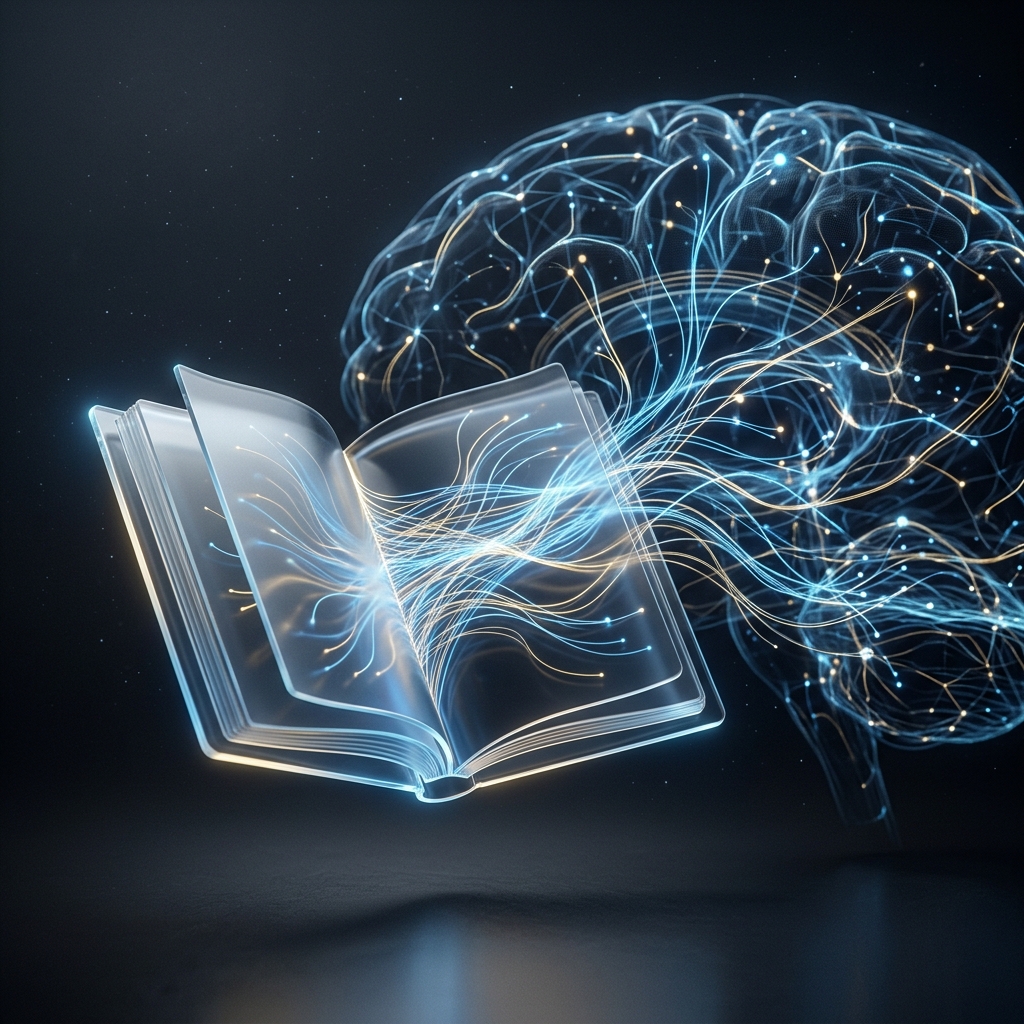
From an evolutionary standpoint, reading is a bizarre anomaly.
Human beings have been speaking for roughly 100,000 years, but reading was only invented about 5,000 years ago. Geologically speaking, that is a blink of an eye. Because reading is so recent, we were never born with a "reading brain." There are no genes or pre-configured neural structures designed specifically for translating abstract symbols into stories and ideas.
Yet, you can look at black marks on a white screen or a piece of paper, and instantly hear a voice in your head, see a vibrant landscape, or feel a surge of grief or excitement.
How is this possible? The answer lies in the brain's ultimate superpower: neuroplasticity. When we learn to read, our brain performs a series of breathtaking neural adaptations that fundamentally rewrite our cognitive architecture.
Here is what actually happens inside your brain when you open a book.
1. Neuronal Recycling: The Visual Letterbox
Because there is no pre-existing "reading center" in the brain, it must engage in a process called Neuronal Recycling—a term coined by neuroscientist Stanislas Dehaene.
The brain borrows neural networks originally evolved for other purposes (like object recognition and tracking prey) and repurposes them to recognize letters and words.
This transformation centers on a tiny patch of the brain located in the left hemisphere's fusiform gyrus: the Visual Word Form Area (VWFA), often referred to by scientists as the brain's letterbox.
- Before learning to read, this area fires up to identify shapes, patterns, and faces in nature.
- As we acquire literacy, the VWFA is hijacked. It adapts to recognize visual symbols (graphemes) and instantly routes them to our language comprehension networks.
When you read fluently, the VWFA bypasses the slow, conscious step of "sounding out" each letter (the phonological route). Instead, it reads entire words at a glance (the lexical route), translating visual shapes into semantic meaning in less than 150 milliseconds.
2. Embodied Cognition: Simulating Reality
Have you ever read a suspenseful novel and felt your heart race, or read about a delicious meal and felt your mouth water? This is not just a psychological reaction; it is a neurological simulation.
Cognitive scientists refer to this as Embodied Cognition. When we read descriptive text, our brain does not treat it as passive data. Instead, it activates the sensory and motor areas of the brain as if we were experiencing the events ourselves.
- In a landmark study led by Emory University, researchers scanned participants' brains over consecutive days while they read a thriller novel. They found heightened connectivity in the somatosensory cortex (which processes physical sensations) and the motor cortex (which controls movement).
- When you read a sentence like "She grabbed the rough rope" or "He ran down the path," your brain activates the exact same neurons that fire when you physically touch a rope or run.
Reading is, quite literally, a low-cost virtual reality simulator. Your brain cannot tell the difference between reading about an action and performing it.
3. Deep Reading vs. Digital Skimming
Not all reading is created equal. The medium through which you consume text radically dictates your neural activity.
When we read a physical book, we engage in Deep Reading. This linear, slow-paced process requires sustained attention, activating prefrontal networks responsible for critical analysis, inference, analogical thinking, and empathy.
By contrast, reading on screens—emails, social media feeds, and digital articles—induces a state of constant distraction. Because screens are packed with links, notifications, and interactive elements, the brain defaults to a rapid skimming pattern.
- Instead of reading left-to-right, line-by-line, the eyes move in an F-shaped pattern, scanning the title, reading the first line, and then scanning down the page for keywords.
- When we skim, we bypass the deep reading brain circuits. Over time, neuroplasticity works against us: the brain becomes exceptionally good at multitasking and scanning, but loses its structural capacity for sustained focus, deep analysis, and contemplative thought.
4. Building the "Cognitive Reserve"
Just like lifting weights builds muscle fibers, reading complex text builds white matter tracts—the myelinated axons that act as the brain's communication highways.
Reading increases the structural connectivity between the visual cortex, the language areas (like Broca’s and Wernicke’s areas), and the prefrontal lobe. This enhanced connectivity creates a stronger, more resilient brain.
In medicine, this is known as building the Cognitive Reserve. Individuals who read regularly throughout their lives build a denser, more interconnected neural network. When neurodegenerative diseases (like Alzheimer's or dementia) begin to damage the brain, individuals with high cognitive reserves can bypass damaged pathways, maintaining cognitive function far longer than non-readers.
The Active Reader's Neuro-Optimization Checklist
To maximize the neurological benefits of your reading sessions, apply this science-backed blueprint:
- Engage the Motor System (Marginalia): Don't just read passively. Highlight, write questions in the margins, and summarize key points. Activating your motor cortex during reading dramatically enhances long-term memory encoding.
- Read 20 Minutes in Print Daily: To protect your deep reading circuitry from digital skimming decay, dedicate at least 20 minutes a day to a physical book, paper document, or distraction-free e-ink reader.
- Visualize the Scene: Actively imagine the sights, sounds, smells, and movements described in the text. This intentional visualization forces sensory cortex activation and deepens comprehension.
Peer-Reviewed Scientific Citations & Landmark Evidence
Neuronal Recycling & Cerebral Changes Induced by Literacy Acquisition:
Dehaene S, Cohen L, Morais J, Kolinsky R. "Illiterate to literate: behavioural and cerebral changes induced by reading acquisition." Nature Reviews Neuroscience, 2015 Apr;16(4):234-44.
🔗 PubMed PMID: 25783611 | DOI: 10.1038/nrn3924Short- and Long-Term Effects of Reading on Brain Functional Connectivity:
Berns GS, Blaine K, Prietula MJ, Pye BE. "Short- and long-term effects of a novel on connectivity in the brain." Brain Connectivity, 2013;3(6):590-600.
🔗 PubMed PMID: 24308529 | DOI: 10.1089/brain.2013.0166Cognitive Reserve in Ageing and Alzheimer's Disease:
Stern Y. "Cognitive reserve in ageing and Alzheimer's disease." The Lancet Neurology, 2012 Nov;11(11):1006-12.
🔗 PubMed PMID: 22981971 | DOI: 10.1016/S1474-4422(12)70191-6An Anatomical Signature for Literacy and White Matter Integrity:
Carreiras M, Seghier ML, Baquero S, et al. "An anatomical signature for literacy." Nature, 2009 Oct 15;461(7266):983-6.
🔗 PubMed PMID: 19829373 | DOI: 10.1038/nature08461
Recommended Reading
- Proust and the Squid: The Story and Science of the Reading Brain by Maryanne Wolf – A landmark book exploring how the human brain adapted to read, the developmental challenges like dyslexia, and how literacy alters our consciousness.
- Reader, Come Home: The Reading Brain in a Digital World by Maryanne Wolf – An urgent look at how digital screens, multitasking, and constant distractions are changing the structure of our brains and eroding our capacity for critical analysis.
- Meditations by Marcus Aurelius – A masterclass in stoicism and cognitive control. Engaging with these ancient, dense reflections is the ultimate training ground to rebuild your focus and exercise your deep reading muscles.
Actionable Longevity Checklist: Next Steps
Scientific insights have maximum power when translated into micro-habits. Check off your daily targets:
Log in Habitspan Daily Protocol (15s)
Lock your 4 biological pillars daily with zero friction and zero tedious data entry.
Calculate Your Biological Cell Age
Assess your functional longevity score against chronological birth age using Medicine 3.0 metrics.