The Protein-Autophagy Paradox: Nutritional Architecture for Muscle Longevity and Cellular Recycling
How to navigate the delicate balance between muscle protein synthesis and cellular cleansing without accelerating biological aging.
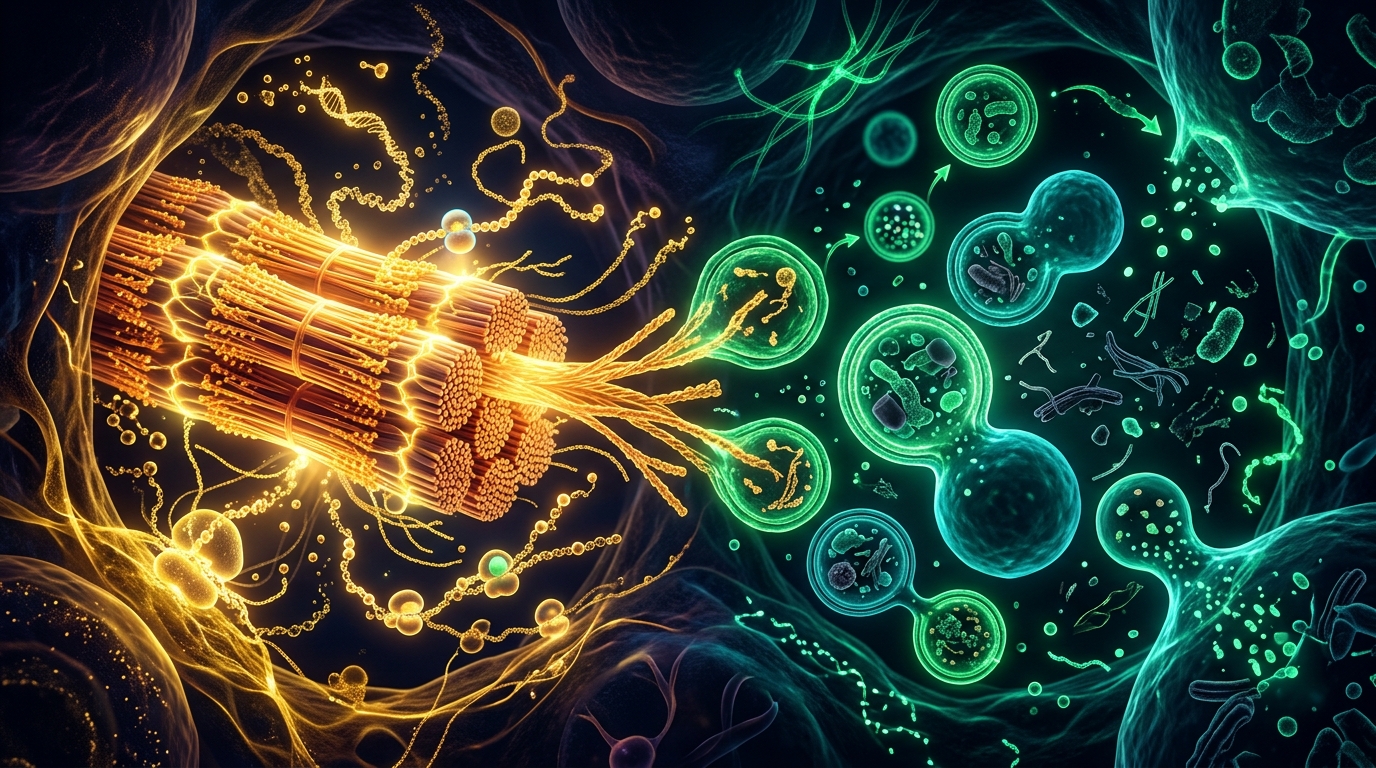
In the modern longevity space, there is a fierce biochemical tension that divides researchers and practitioners into two seemingly opposing camps:
- The Gerontologists' Argument: Fasting, caloric restriction, and down-regulating the nutrient-sensing enzyme mTOR stimulates autophagy, clearing senescent cells and misfolded proteins to extend lifespan. In model organisms, animals with low protein intake and suppressed mTOR live substantially longer.
- The Clinical Medicine 3.0 Argument: Muscle mass and physical strength are the strongest non-genetic predictors of all-cause mortality in humans. Sarcopenia (age-related muscle wasting) is a death sentence in the eighth and ninth decades of life. To maintain skeletal muscle, one requires substantial dietary protein (1.6 to 2.2 grams per kilogram of body weight per day) to trigger Muscle Protein Synthesis (MPS).
This creates the Protein-Autophagy Paradox: If dietary protein activates mTOR and suppresses autophagy, can we preserve vital skeletal muscle without accelerating cellular senescence and metabolic decay?
The answer lies not in chronic starvation or reckless overfeeding, but in dynamic nutrient cycling and biochemical pulsing. Here is the exact nutritional architecture to solve this paradox.
1. Skeletal Muscle: The Metabolic Sink for Longevity
To understand why we cannot simply fast continuously to maximize autophagy, we must view skeletal muscle through the lens of metabolic endocrinology.
Muscle is not merely decorative tissue for locomotion; it is your body's largest endocrine organ and its primary metabolic sink:
- Glucose Disposal: Over 80% of postprandial glucose clearance occurs in skeletal muscle through insulin-stimulated GLUT4 translocation. High muscle mass acts as a protective buffer against insulin resistance and type 2 diabetes.
- Amino Acid Reservoir: When you contract a systemic infection, undergo major surgery, or suffer trauma, your immune system requires an immense influx of amino acids. If you lack adequate muscle mass, your body scavenges vital organs and immune cells, drastically increasing fatality rates.
- Fall Prevention & Bone Density: Accidental falls and resultant hip fractures carry a 20–30% one-year mortality rate in elderly populations. Muscle mass and grip strength are the physical shock absorbers protecting skeletal integrity.
Under-eating protein in pursuit of perpetual autophagy inevitably causes sarcopenia and osteopenia, swapping a hypothetical long-term cellular risk for an immediate clinical catastrophe.
2. The Leucine Trigger and the Anabolic Threshold
A common misconception is that consuming protein elevates mTOR continuously throughout the day. In reality, Muscle Protein Synthesis operates on an "all-or-none" threshold, primarily dictated by the essential branched-chain amino acid leucine.
The Leucine Threshold
To switch on protein translation in skeletal muscle via mTORC1 and p70S6K, cellular leucine concentration must reach an intracellular threshold (approximately 2.5 to 3.0 grams of leucine in a single bolus, equivalent to roughly 30–40 grams of high-quality intact protein).
- Sub-threshold Dosing (Snacking): Consuming 10 grams of protein every two hours fails to hit the leucine trigger for muscle synthesis, yet provides just enough circulating amino acids to suppress autophagy. This is the worst of both worlds.
- Supra-threshold Boluses (Pulsing): Consuming 35–50 grams of protein in distinct, spaced meals triggers robust muscle protein synthesis for approximately 2 to 3 hours, after which the muscle enters a refractory period ("muscle full" effect) and systemic amino acid levels subside.
By consuming protein in concentrated boluses rather than grazing constantly, you create distinct metabolic windows where mTOR is pulsed for tissue repair, followed by clear intervals where autophagy can resume.
3. The Nutritional Architecture: Pulsing mTOR and Autophagy
Solving the paradox requires oscillating between the Anabolic State (Building) and the Catabolic State (Recycling) across the 24-hour circadian cycle and throughout the annual calendar.
| Time Window | Nutritional Event | Protein Target | Biochemical State | Cellular Mechanism |
|---|---|---|---|---|
| 08:00 | Meal 1 (Breakfast) | 35–45g (2.5–3g leucine) | mTOR ON (Anabolic) | Triggers Muscle Protein Synthesis (MPS) for 2–3 hours |
| 13:00 | Meal 2 (Lunch) | 35–45g (2.5–3g leucine) | mTOR ON (Anabolic) | Sustains nitrogen balance and tissue remodeling |
| 19:00 | Meal 3 (Dinner) | 35–45g (2.5–3g leucine) | mTOR ON (Anabolic) | Final feeding window; completed ≥ 3 hours before bed |
| 22:00 – 08:00 | Nocturnal Sleep & Fast | 0 kcal (Fast water only) | AMPK ON (Catabolic) | Deep cellular autophagy, mitophagy, and glymphatic clearance |
Pillar A: The 14:10 or 16:8 Circadian Fasting Window
- Confine all protein and caloric intake to an 8- to 10-hour daytime window (e.g., 9:00 AM to 6:00 PM or 10:00 AM to 7:00 PM).
- During the fasting window (14 to 16 hours, especially the 8 hours of nocturnal sleep), insulin drops to basal levels, hepatic glycogen depletes, and AMPK elevates, activating deep cellular autophagy and mitophagy in hepatocytes, endothelial cells, and neurons.
Pillar B: Adequate Daily Protein Distribution
- Target 1.6 to 2.2 g of protein per kilogram of body weight (or roughly 1 g per pound of ideal body weight).
- Divide this total into 2 to 3 discrete boluses separated by at least 4 to 5 hours.
- Ensure each meal contains at least 2.5–3g of leucine (sourced from eggs, wild fish, grass-fed poultry, Greek yogurt, or leucine-fortified plant protein).
Pillar C: Mitophagy via Zone 2 Cardio
Do not rely exclusively on nutrient deprivation to stimulate autophagy. Muscle contraction and cellular ATP depletion during Zone 2 cardiovascular training (45–60 minutes at 60–70% max heart rate) powerfully activate AMPK and trigger mitophagy (the specific recycling of defective mitochondria) even in the fed state.
4. Key Takeaways for High-Performance Longevity
- Muscle is non-negotiable: Prioritize 1.6–2.2g/kg/day of protein to safeguard metabolic health and defend against sarcopenia.
- Stop grazing: Graze-eating keeps mTOR continually active without ever reaching the anabolic leucine threshold or allowing autophagic cleanup.
- Pulse with intention: Consume 2–3 high-protein meals within an 8–10 hour feeding window, then step aside and let nocturnal fasting do its cellular housekeeping.
- Leverage exercise: Zone 2 cardio and heavy resistance training are potent non-dietary stimulants of mitochondrial recycling and insulin sensitivity.
Recommended Reading
To dive deeper into the clinical science of protein metabolism, cellular recycling, and long-term healthspan engineering, explore these essential texts:
- Outlive: The Science and Art of Longevity by Dr. Peter Attia, M.D.
The definitive manual on Medicine 3.0, detailing why skeletal muscle mass is the primary metabolic sink and how exercise is the ultimate longevity drug. - The Longevity Diet by Valter Longo, Ph.D.
A groundbreaking exploration of fasting-mimicking diets, cellular rejuvenation, and nutrient signaling pathways that dictate human lifespan. - The Almanack of Naval Ravikant by Eric Jorgenson
A masterclass on mental models, foundational health habits, and cultivating sovereign physical and financial wealth.
Peer-Reviewed Scientific Citations & Landmark Evidence
Leucine and the Regulation of mTOR and Muscle Protein Synthesis:
Drummond MJ, Rasmussen BB. "Leucine-enriched nutrients and the regulation of mTOR signalling and human skeletal muscle protein synthesis." Current Opinion in Clinical Nutrition & Metabolic Care, 2008 May;11(3):222-6.
🔗 PubMed PMID: 18408562 | DOI: 10.1097/MCO.0b013e3282fa17fbIngested Protein Dose Response of Muscle Protein Synthesis:
Moore DR, Robinson MJ, Fry JL, Tang JE, et al. "Ingested protein dose response of muscle and albumin protein synthesis after resistance exercise in young men." American Journal of Clinical Nutrition (AJCN), 2009 Jan;89(1):161-8.
🔗 PubMed PMID: 19056590 | DOI: 10.3945/ajcn.2008.26401Sarcopenia, Muscle Mass Loss, and Mortality Risk in Aging:
Landi F, Cruz-Jentoft AJ, Liperoti R, et al. "Sarcopenia and mortality risk in frail older persons aged 80 years and older." JAMDA, 2013 Mar;14(3):207-12.
🔗 PubMed PMID: 23395032 | DOI: 10.1016/j.jamda.2012.11.000Early Time-Restricted Feeding Improves Insulin Sensitivity & Autophagy:
Sutton EF, Beyl R, Early KS, Cefalu WT, Ravussin E, Peterson CM. "Early Time-Restricted Feeding Improves Insulin Sensitivity, Blood Pressure, and Oxidative Stress Even without Weight Loss in Men with Prediabetes." Cell Metabolism, 2018 Jun 5;27(6):1212-1221.e3.
🔗 PubMed PMID: 29752076 | DOI: 10.1016/j.cmet.2018.04.010Skeletal Muscle Insulin Resistance as the Primary Defect in Metabolic Disease:
DeFronzo RA, Tripathy D. "Skeletal muscle insulin resistance is the primary defect in type 2 diabetes." Diabetes Care, 2009 Nov;32 Suppl 2:S157-63.
🔗 PubMed PMID: 19564468 | DOI: 10.2337/dc09-S302
Actionable Longevity Checklist: Next Steps
Scientific insights have maximum power when translated into micro-habits. Check off your daily targets:
Log in Habitspan Daily Protocol (15s)
Lock your 4 biological pillars daily with zero friction and zero tedious data entry.
Calculate Your Biological Cell Age
Assess your functional longevity score against chronological birth age using Medicine 3.0 metrics.