The Psychological Anatomy of Shadow Work: Why Most Journals Fail and How to Map Your Repressed Self
Moving beyond generic prompts to decode your subconscious defense mechanisms, reclaim hidden psychological assets, and master Carl Jung's self-integration.
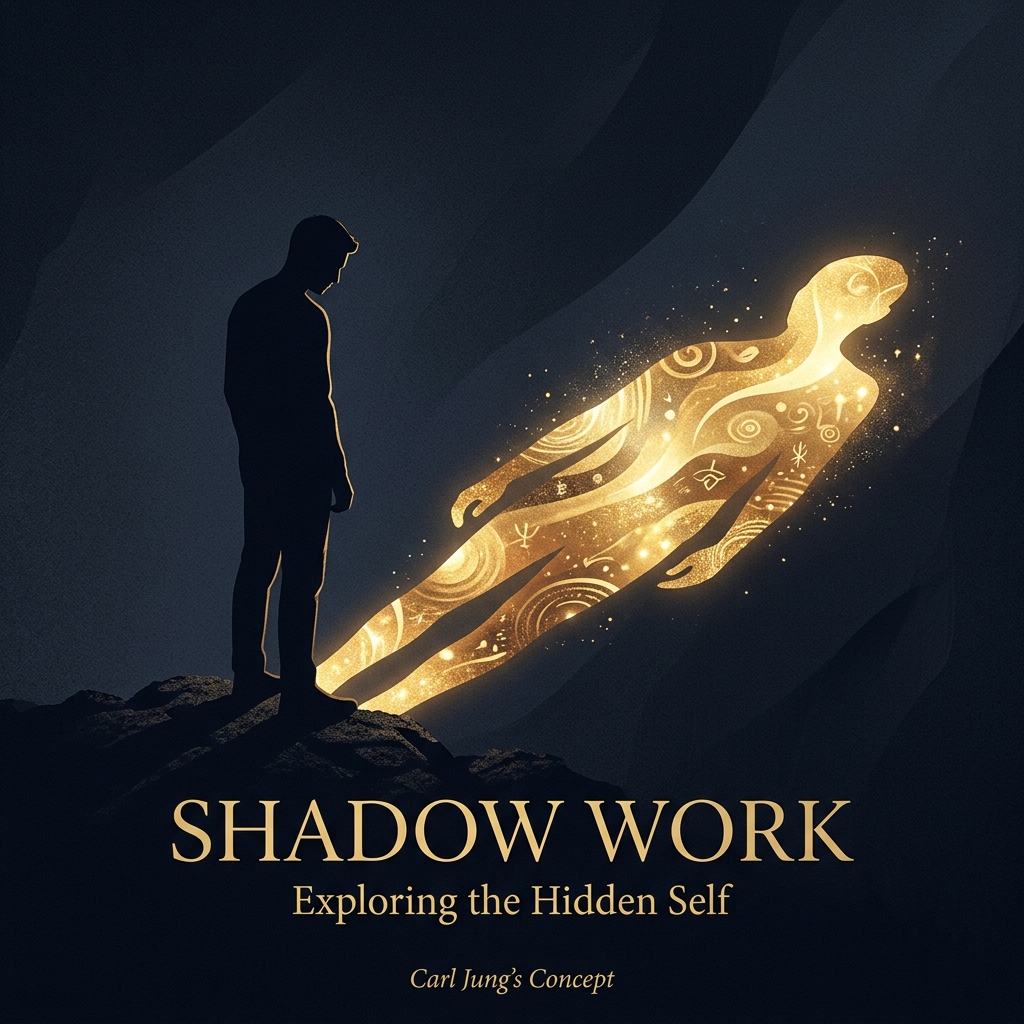
"Until you make the unconscious conscious, it will direct your life and you will call it fate." — Carl Jung
We spend our entire lives constructing a persona: a carefully curated version of ourselves that we present to our colleagues, our families, and our social feeds. We want to be seen as rational, competent, kind, and in control. But in building this bright, polished exterior, we inevitably cast a shadow.
In Jungian psychology, the Shadow refers to the parts of our psyche that we have rejected, repressed, or denied. These aren't necessarily "bad" traits; they are simply the aspects of ourselves that our early conditioning taught us were unacceptable.
A Shadow Work Journal is the ultimate diagnostic tool to bridge the gap between your conscious mind and your hidden self. However, most modern journaling advice completely misses the point. They treat shadow work as a form of emotional venting or a trendy self-care aesthetic.
Here is the psychological reality of shadow work, why standard journals fail, and a high-agency framework to integrate your shadow.
1. The Three Traps of Modern Shadow Work Journals
Many people buy a journal, write down their frustrations, and wonder why their behaviors don't change. Real shadow work is uncomfortable; it requires dismantling your psychological defenses. If your journal is comforting, you are likely falling into one of these traps:
- The Catharsis Trap (Raw Venting): Writing down raw, angry thoughts feels good in the moment. However, cognitive science shows that venting without reflection does not heal—it actually reinforces the neural pathways of anger and victimhood. Shadow work is not about venting the emotion; it is about uncovering the unconscious rule that triggered the emotion.
- The Spiritual Bypass: Using high-level spiritual jargon ("energy blocks," "vibrations") to intellectualize your wounds. If you explain away your toxic patterns using abstract terms rather than looking at your real, daily behaviors, you are using the journal to protect your ego rather than inspect it.
- Projection Blindness: The shadow cannot be seen directly; it can only be seen in reflection. The most common form of shadow defense is projection—attributing your disowned traits to others. If your journal is a list of how other people are selfish, lazy, or manipulative, you are blind to the fact that you are projecting your own repressed capacity for those traits onto them.
2. The Mechanics of the Shadow: Projection and Re-integration
To do effective shadow work, you must understand the mirror of Projection.
Whenever someone's behavior triggers an outsized, irrational emotional reaction in you (anger, intense irritation, or obsession), you are looking at a mirror of your shadow.
For example:
- If you are deeply irritated by people who are self-promoting or loud, your shadow may contain a repressed desire for attention and recognition that you've deemed "arrogant."
- If you hate people who set strict boundaries or say "no" easily, your shadow may contain a disowned need to protect your own energy, which you've labeled as "selfish."
The Golden Shadow
Importantly, we do not only repress our flaws. We also repress our strength, creativity, and leadership. This is known as the Golden Shadow. When you experience intense admiration, envy, or idealization of another person, you are projecting your own disowned greatness onto them. You believe they have the talent or charisma that you lack, avoiding the scary responsibility of stepping into your own potential.
3. The Integration Protocol: The S.H.A.D.O.W. Framework
Instead of journaling aimlessly, use this structured, six-step protocol to identify, analyze, and integrate shadow patterns:
- Spot the Trigger: Write down a recent event where you felt a strong, irrational emotional charge (anger, jealousy, irritation).
- Historical Audit: Ask: "When was the first time I felt this way?" Identify the childhood or adolescent rules you created to keep yourself safe (e.g., "If I speak up, I will be rejected").
- Analyze the Secondary Gain: Every recurring negative behavior has a payoff. If you constantly play the victim or people-please, ask: "What does this behavior protect me from?" (e.g., people-pleasing prevents the discomfort of confrontation).
- Dismantle the Projection: Write down the triggered trait and ask: "In what ways do I exhibit this trait, or desperately suppress it at the expense of my authenticity?"
- Own the Golden Shadow: Identify who you envy. List their qualities. Ask: "How can I begin to manifest these qualities in my own life rather than placing them on a pedestal?"
- Write New Behavioral Habits: Re-integration is useless without behavior change. Design one small, daily action that challenges the old defense mechanism.
4. Three High-Agency Shadow Work Prompts
To begin your practice, set aside 20 minutes of uninterrupted time, open your journal, and answer these three prompts with absolute, unfiltered honesty:
Prompt 1: The Irritation Inventory
Identify 2-3 people in your immediate life (or public figures) whose behaviors irritate you the most. What are the specific traits you dislike? How do you suppress these traits in yourself, or where do you secretly wish you had the freedom to act that way?
Prompt 2: The Resentment Compass
Resentment is the ultimate diagnostic indicator of a crossed boundary or an unexpressed desire. Where do you feel resentment right now? Who or what is it directed towards? What boundary did you fail to set, or what unexpressed need are you refusing to communicate?
Prompt 3: The Golden Shadow Audit
Think of someone whose work or personality you highly admire or find intimidating. What traits do they possess that you believe you completely lack? In what small, daily ways can you start practicing those exact traits?
The Integration Blueprint
Shadow work is not a one-time event; it is a life-long process of psychological retrieval. By writing down your triggers and systematically analyzing them, you stop being a victim of your subconscious programming. You transition from a fractured persona to a whole, integrated individual.
Peer-Reviewed Scientific Citations & Psychological Evidence
Expressive Writing, Emotional Inhibition, and Health (Pennebaker Paradigm):
Pennebaker JW, Beall SK. "Confronting a traumatic event: toward an understanding of inhibition and disease." Journal of Abnormal Psychology, 1986 Aug;95(3):274-81.
🔗 PubMed PMID: 3805704 | DOI: 10.1037/0021-843X.95.3.274Catharsis and Rumination vs. Cognitive Reframing:
Bushman BJ. "Does venting anger feed or extinguish the flame? Catharsis, rumination, distraction, anger, and aggressive responding." Personality and Social Psychology Bulletin, 2002 Jun;28(6):724-31.
🔗 PubMed PMID: 12051675 | DOI: 10.1177/0146167202289002Rethinking Rumination and Emotional Regulation:
Nolen-Hoeksema S, Wisco BE, Lyubomirsky S. "Rethinking Rumination." Perspectives on Psychological Science, 2008 Sep;3(5):400-24.
🔗 PubMed PMID: 26158958 | DOI: 10.1111/j.1745-6924.2008.00088.xAnalytical Psychology and the Archetype of the Shadow:
Jung CG. "The Archetypes and the Collective Unconscious." Collected Works of C.G. Jung, Vol. 9 (Part 1), Princeton University Press.
DOI: 10.1515/9781400850952
Recommended Reading
- Meditations by Marcus Aurelius – The personal logs of the Roman Emperor. A fundamental diary of self-restraint, duty, mindset mastery, and practical Stoic resilience.
- The Body Keeps the Score by Bessel van der Kolk M.D. – A landmark book in psychology showing how repressed emotions and trauma are stored physically in the body, offering pathways for healing.
- Think Again by Adam Grant – Learn how to build cognitive humility, challenge your own long-held assumptions, and build the habit of continuous self-rethinking.
Actionable Longevity Checklist: Next Steps
Scientific insights have maximum power when translated into micro-habits. Check off your daily targets:
Log in Habitspan Daily Protocol (15s)
Lock your 4 biological pillars daily with zero friction and zero tedious data entry.
Calculate Your Biological Cell Age
Assess your functional longevity score against chronological birth age using Medicine 3.0 metrics.